13 October, 2026 | 02:16
A new channel, language version or platform creates another revenue opportunity for a media company. The cost and speed of launch depend partly on how much of the existing content preparation, playout and delivery workflow can be reused.
Discussions at IBC 2026 about AI, personalisation, IP and monetisation raise a common question: how can media businesses increase output and reach while keeping costs and service quality under control? In our view, much of the answer lies in how work moves between individual technology stages.
Examples from IBC show where AI is already reducing routine work. Australia’s ABC uses it for automated transcription and archive search. Olympic Broadcasting Services (OBS) uses AI to generate sports highlights automatically.
The business impact depends on what happens next. Faster transcription makes little difference to publication time if teams then transfer material manually between systems and check the same data again. What matters is the complete journey from receiving content to having it ready for transmission or publication: how long it takes, how many manual steps it involves and where human oversight is needed.
Entering new markets adds language versions, rights conditions and advertising requirements. Personalisation introduces further variations in how content is presented to different audiences.
At IBC, a KPN representative warned that hyperpersonalisation can sharply increase operational complexity unless costs and resource requirements remain under control. A more tailored viewing experience needs a sound business case.
Sport illustrates the scale of the challenge. OBS plans to produce more than 14,000 hours of content for the LA28 Olympic Games. To handle that volume, it is changing its operating model around virtualisation, AI and cloud technology.
Automation allows established workflows to be reused for new channels and versions. System integration reduces manual transfers of content and data. Together, they can lower the cost of the next launch, provided additional integration, testing and support do not consume the savings.
According to figures presented by YouTube at IBC, viewers watch more than one billion hours of its content on television screens every day. Separately, Nielsen reports that streaming accounted for 49% of total US television viewing in July 2026, with YouTube at 14.2%.
For content owners, this reinforces the importance of reaching audiences across platforms. Subject to the relevant rights, the same content can appear on a broadcast channel, a subscription OTT service, a free ad-supported streaming television (FAST) channel and social media. Each outlet has its own requirements for formats, access, delivery and audience measurement.
Different revenue models can operate in parallel. The programme for an IBC sports session illustrated this through a tournament available free-to-air in one market, through a subscription in another, as a one-off event pass in a third and within an operator bundle in a fourth.
Advertising is also becoming a larger part of streaming revenue. PwC’s 2026–2030 outlook forecasts global OTT revenue growth of 6.1% a year, with advertising’s share rising from 19.4% to 22.6% by the end of the period.
Capturing these opportunities requires the commercial model and technical implementation to work together: access, advertising integrations, delivery and reporting all need to be in place. The time and cost involved affect when a new offering can start generating revenue and whether it can become profitable.
Television’s transition to IP was a dedicated topic in the IBC 2026 programme. For media businesses, it creates opportunities to extend distribution by connecting operators and platforms, adding regional channel versions and serving new reception points.
The result depends on connection quality, system interoperability, redundancy and monitoring. The economic benefit comes when a new destination can be incorporated into existing configuration and support processes without a substantial increase in manual work.
Planning IP delivery therefore means considering the full signal path, responsibility for each part of it and the response when something fails.
System interoperability determines how much work it takes to introduce a new tool or replace an outdated component.
At IBC, Netflix described bringing third-party tools into its Media Production Suite environment through its Tool Library. These tools must meet the company’s requirements for security, rights and responsible use.
Another example is MovieLabs’ Ontology for Media Creation, which provides a shared structure for describing production data across systems.
Consistent data structures and well-designed integrations make workflows easier to change. New capabilities can be introduced gradually, reducing repeated configuration and manual information transfers.
Faster channel and service launches, lower operating costs, access to new markets and additional revenue provide a basis for assessing technology changes. Practical measures include launch time, the number of manual steps, the cost of supporting each additional channel or platform, and service stability.
Cosmonova Broadcast provides OTT service launches, linear and FAST channel playout, managed IP delivery to operators and platforms, and live streaming for TV channels and events. Our services run on geo-redundant infrastructure in the EU and are brought together in the All Services Platform (ASP). Configuration reflects each project’s requirements, with our operations team supporting the automated workflows.
For us, the central question after IBC 2026 is how much time, resource and additional configuration the next launch will require. That is where the impact of automation and integration on media economics becomes clear.
A summary of Cosmonova Broadcast’s operational scale, infrastructure upgrades, and key milestones across playout, IP distribution, OTT, and streaming in 2025
Cloud adoption is no longer the main question for media companies. The key challenge today is architecture. Learn how integrated cloud infrastructure improves operational stability, scalability, security, playout, and IP distribution for broadcasters and OTT services

Ukraine offers simplified market entry for EU linear broadcasters. Cosmonova Broadcast acts as an operational entry point, providing the full media supply chain - from channel deployment and localization to distribution and multiplatform IP delivery

Meet Cosmonova Broadcast at IBC 2026 in Amsterdam to discuss managed media services, workflow automation, playout, IP delivery, streaming, OTT, and monetisation

One TV channel delivery request evolved into an integrated media operations project covering multiplatform distribution, managed playout, FAST, VOD, OTT, and live streaming
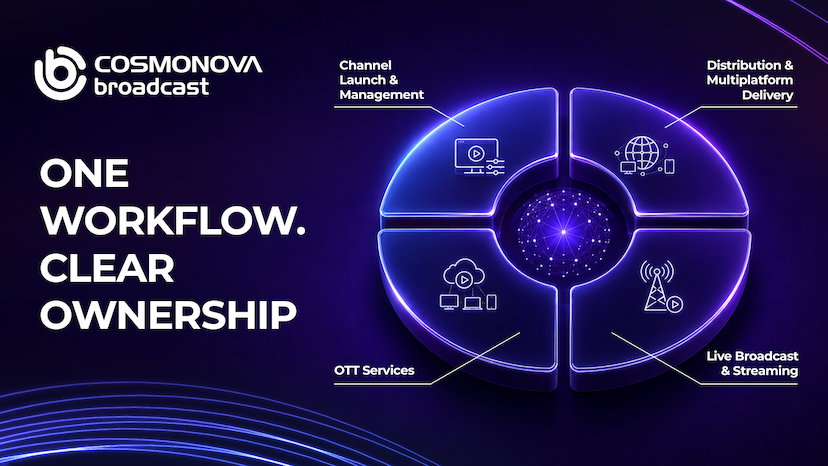
All Services Platform brings TV channel playout, localisation, distribution, OTT, live streaming, NOC monitoring and technical support into one managed operational workflow with SLA-based accountability. Media companies can launch channels and OTT services, expand to new markets and scale operations without building separate technology chains
Cosmonova Broadcast will showcase the COSMO | PLAYOUT mobile app and the new Clip Live feature in the updated WEBREC at IBC 2026 in Amsterdam. Both updates will be on display at stand 1.F14
Managed geo-redundant infrastructure, 24/7 NOC monitoring, technical support, and clearly defined operational procedures enable Cosmonova Broadcast to deliver a 99.98% SLA