08 April, 2026 | 14:13
Cloud adoption is no longer a matter of debate for most media companies. The focus has shifted from the question of whether to use cloud environments to how to architect them.
It is the architecture that determines how stable, secure, and predictable services are and how effectively operations are supported.
The past: cloud under scrutiny
Decades ago, cloud infrastructure was viewed as a risky alternative to on-prem solutions, particularly for mission-critical media workflows.
These concerns were well-founded. Early solutions did not provide sufficient network stability, predictable latency, or mature security and access control mechanisms, and, consequently, could not guarantee robust SLA commitments.
More innovation-driven media companies used cloud for storage, while processing, playout, and distribution remained within on-prem environments.
The present: cloud as part of the infrastructure model
Today, cloud technologies are becoming integral to media infrastructure.
They enable key capabilities:
Reliability: geo-distributed architectures, redundancy, and failover mechanisms ensure service continuity.
Security: data encryption, access management systems, and auditing provide controlled and verifiable content environments.
Efficiency: elastic scalability, cost optimisation, and rapid deployment simplify the launch and growth of media services.
Architecture is the foundation of operational stability
Cloud migration is seen as a step toward transformation and growth.
However, its success relies not just on changing environments but on how system components are integrated into a unified architecture. Without alignment among business requirements, operational workflows, and technical architecture, existing limitations are simply transferred to the new environment.
For media companies, manageability and infrastructure integrity are crucial. An integrated architecture covering the full media lifecycle eliminates fragmentation. All components work together in a coordinated way, with service quality aligned to SLA commitments.
Cloud migration in practice
Fast and predictable cloud migration can be critical for media.
We approach this transition as a structured process - from auditing existing infrastructure and designing the target architecture to content migration, service configuration, and operational launch in the cloud environment - without disrupting core workflows.
For example, in one project, we supported a client in migrating approximately 20 TB of content from three separate locations into a cloud environment and integrating it into playout within a single day. The client subsequently transitioned to cloud-based storage, playout, and IP channel distribution, gradually scaling operations across Europe.
Conclusion
The value of cloud migration is not defined by where your infrastructure runs. It is defined by how stable, secure, and efficient your media operations are, and how easily they can scale.

In the past, content value was created at the production stage. Changes in consumption and monetization have forced media companies to rethink the value of content delivery
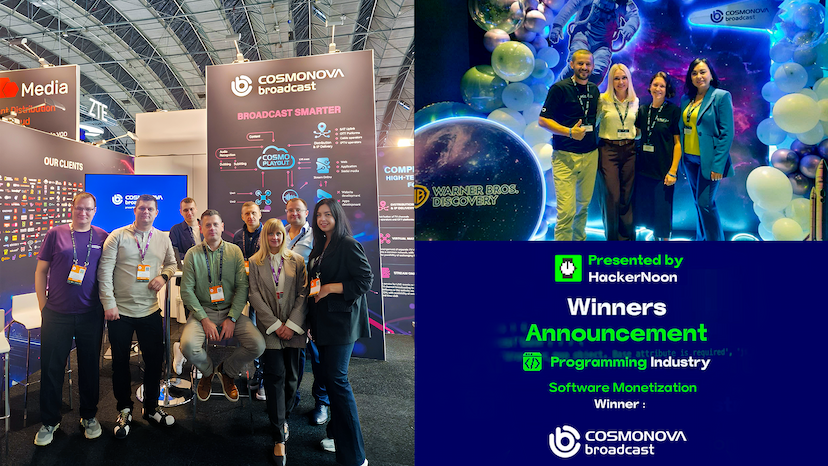
A summary of Cosmonova Broadcast’s operational scale, infrastructure upgrades, and key milestones across playout, IP distribution, OTT, and streaming in 2025
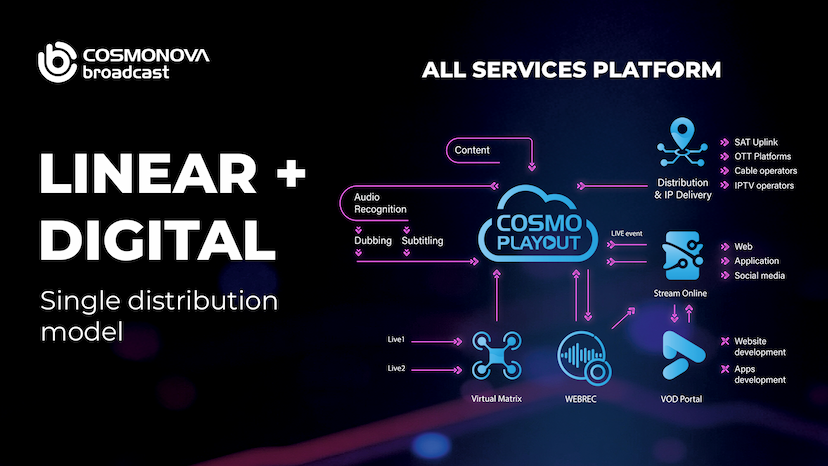
The distinction between linear TV and digital platforms is fading as audiences consume content across multiple environments. Coordinated multiplatform distribution is becoming essential for broadcasters

Ukraine offers simplified market entry for EU linear broadcasters. Cosmonova Broadcast acts as an operational entry point, providing the full media supply chain - from channel deployment and localization to distribution and multiplatform IP delivery
.png&w=828&q=75 "Always-On Media Keeps Revenue Flowing - Photo")
Technology can be replaced. Features can be copied. But the operating model behind them is what creates measurable advantage
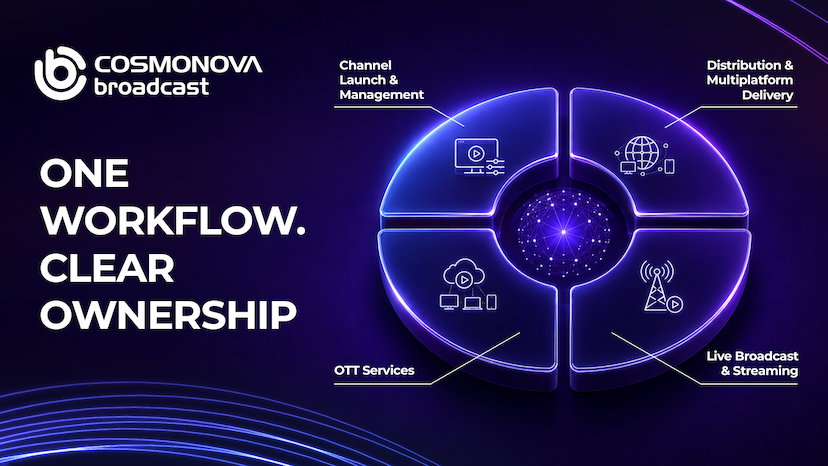
All Services Platform brings TV channel playout, localisation, distribution, OTT, live streaming, NOC monitoring and technical support into one managed operational workflow with SLA-based accountability. Media companies can launch channels and OTT services, expand to new markets and scale operations without building separate technology chains

Cosmonova Broadcast will showcase the COSMO | PLAYOUT mobile app and the new Clip Live feature in the updated WEBREC at IBC 2026 in Amsterdam. Both updates will be on display at stand 1.F14

Managed geo-redundant infrastructure, 24/7 NOC monitoring, technical support, and clearly defined operational procedures enable Cosmonova Broadcast to deliver a 99.98% SLA