03 February, 2026 | 10:22
In this article, the term media supply chain is used not in a narrow logistical sense. It refers to the operational chain of content supply - from technical preparation and versioning for different platforms, territories, and audiences to distribution, signal delivery, analytics, and monetization management.
For decades, the media industry operated under a production-centric model.
Value was created at the moment of content production, while everything that followed was treated as secondary, purely technical execution.
Today, however, media economics is shifting from production to the orchestration of content supply. Changes in consumption patterns and monetization models have forced media companies to reconsider the very value of content delivery.
Audiences today are fragmented across platforms, services, and devices. At the same time, content rights are increasingly monetized across multiple territories and time windows, each governed by specific regulatory, partner, editorial, and contractual conditions for different platforms. As a result, advertising and sponsorship revenues are becoming increasingly dependent on stable and reliable distribution.
Adaptation and localization enable content to enter new markets. Automation, in turn, reduces operational costs and makes scaling predictable.
Taken together, these factors transform the media supply chain from a technical function into an economically decisive operational layer. In practice, media companies are no longer competing solely on what they produce, but on how efficiently they can deliver content to market.
Tasks that were once considered purely technical - encoding, packaging, subtitling, delivery - have become strategic capabilities. There are three reasons for this.
Revenue is no longer generated through a single release or channel. Rights holders increasingly design phased distribution strategies across regions, platforms, and access models. The supply chain is what makes this segmentation possible. Without flexible content adaptation and controlled delivery, multi-window monetization cannot scale.
Localized dubbing, subtitling, regional graphics, and compliance overlays allow the same content to be monetized repeatedly without additional production. Localization is no longer a cost center; it becomes a revenue multiplier.
For news, sports, and event-based content, a delivery failure is not a technical incident - it is a direct loss of audience, advertising impressions, and partner trust. In this segment, minimal signal latency, redundancy, and readiness for peak loads directly affect revenue and business risk.
It is not a collection of disconnected services, but an integrated operational model that covers the entire content lifecycle - from ingestion to performance measurement and compliance verification (regulatory, platform-specific, and contractual) - that determines a media company’s ability to scale distribution, manage monetization, and reduce operational risk.
This approach becomes essential for organizations that own content or hold distribution rights, operate across multiple territories, platforms, or devices, and seek to maximize reach and monetization. These include international media groups, national and local broadcasters, corporate media, public and cultural institutions, as well as governmental and civic organizations.
Content demand may be consistently cross-border (sports, films, series), independent of socio-demographic differences (documentary, educational, and sociocultural projects), or local and time-bound but mass-scale (news, elections, events, public addresses).
In all cases, the decisive factor is not demand itself, but the ability to deliver content to the right territories, audiences, and platforms at the right time and in the appropriate form.
In today’s media economy, several types of players coexist. Component and service providers focus on individual tools (encoders, CDNs, playlist software modules, subtitling or transcoding solutions). Infrastructure-and-operations providers deliver managed, end-to-end execution under SLA. Monetization platforms attract audiences and convert available content into revenue (OTT and FAST platforms, aggregators, advertising ecosystems, and related environments).
The company combines its own geographically distributed infrastructure with geo-redundancy in the EU, 24/7 managed operations, and an SLA-driven service model.
The company provides a full media supply chain from technical preparation and localization to playout, distribution, IP delivery, and access across multiple platforms and devices.
As a result, rights holders and broadcasters can focus on content and revenue while delegating operational complexity to an infrastructure service partner.
If the 2010s were defined by migration to the cloud, today the industry is facing a new demand: media supply chain maturity. Rights holders and broadcasters are gradually shifting their focus from basic infrastructure questions - “where do we store and play out content?” - to operational and strategic ones: “how do we adapt, align versions, deliver, and monetize content across different territories, platforms, and audiences?”
The media supply chain has emerged as the answer to that question. It does not replace the economic value of production; it multiplies it. Today, it determines how widely, how long, and how effectively that value can be realized.
A summary of Cosmonova Broadcast’s operational scale, infrastructure upgrades, and key milestones across playout, IP distribution, OTT, and streaming in 2025
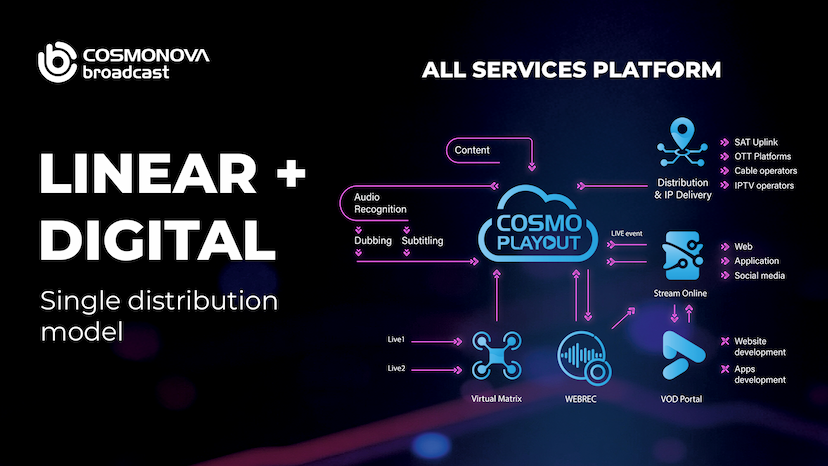
The distinction between linear TV and digital platforms is fading as audiences consume content across multiple environments. Coordinated multiplatform distribution is becoming essential for broadcasters
Cloud adoption is no longer the main question for media companies. The key challenge today is architecture. Learn how integrated cloud infrastructure improves operational stability, scalability, security, playout, and IP distribution for broadcasters and OTT services

Ukraine offers simplified market entry for EU linear broadcasters. Cosmonova Broadcast acts as an operational entry point, providing the full media supply chain - from channel deployment and localization to distribution and multiplatform IP delivery
.png&w=828&q=75 "Always-On Media Keeps Revenue Flowing - Photo")
Technology can be replaced. Features can be copied. But the operating model behind them is what creates measurable advantage
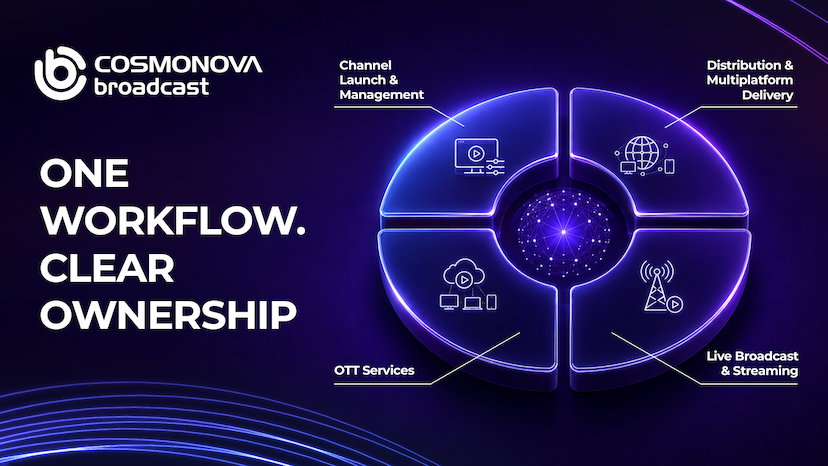
All Services Platform brings TV channel playout, localisation, distribution, OTT, live streaming, NOC monitoring and technical support into one managed operational workflow with SLA-based accountability. Media companies can launch channels and OTT services, expand to new markets and scale operations without building separate technology chains

Cosmonova Broadcast will showcase the COSMO | PLAYOUT mobile app and the new Clip Live feature in the updated WEBREC at IBC 2026 in Amsterdam. Both updates will be on display at stand 1.F14

Managed geo-redundant infrastructure, 24/7 NOC monitoring, technical support, and clearly defined operational procedures enable Cosmonova Broadcast to deliver a 99.98% SLA